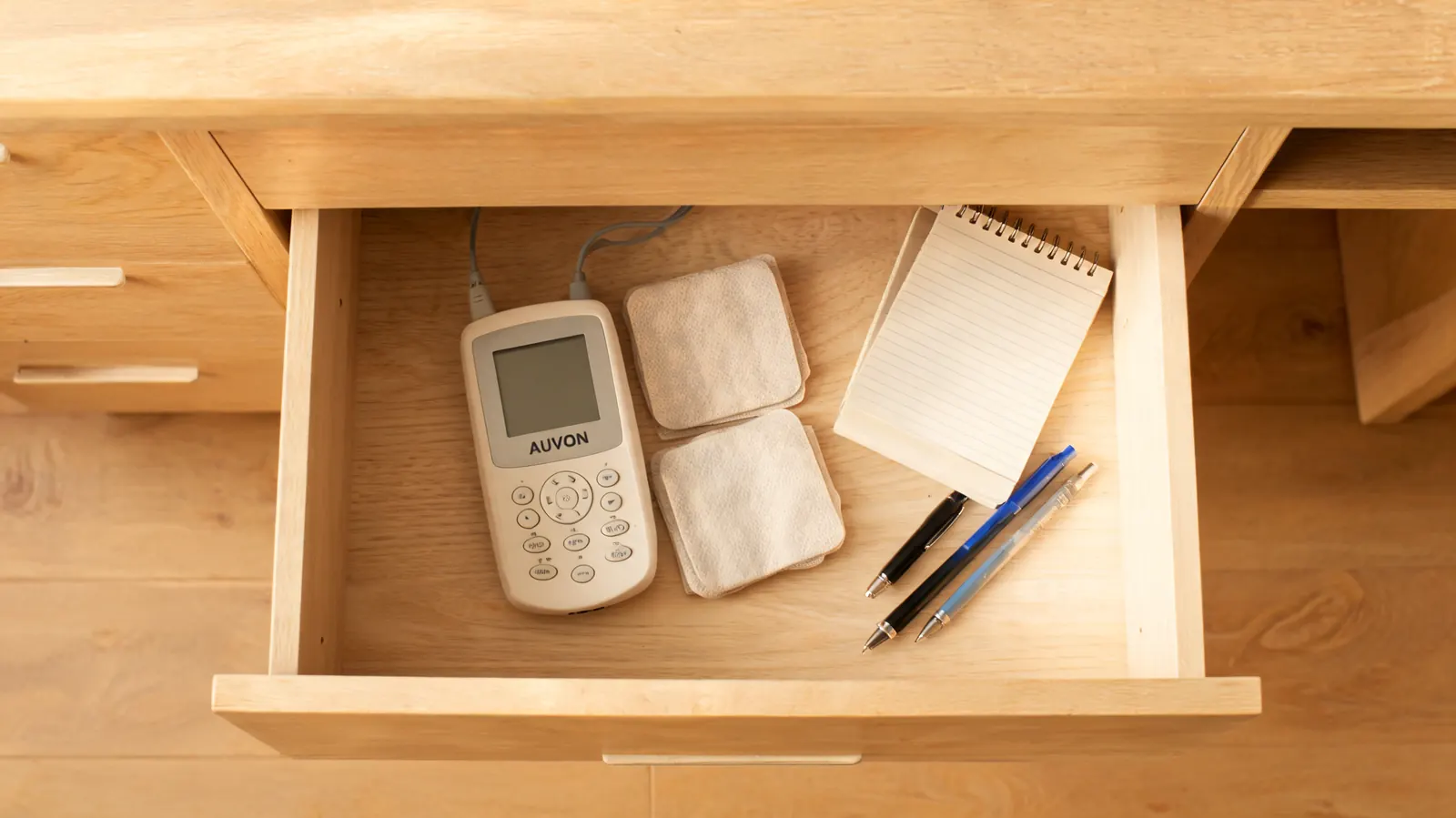
Seven months ago I had a psoriatic arthritis flare that lasted three weeks, and by the end of it I had hit the maximum ibuprofen my rheumatologist wanted me taking on methotrexate weekends. I needed something else. A friend with ankylosing spondylitis mentioned she kept a TENS unit in her bag, and I remember thinking it sounded like something out of a physical therapy clinic from 1987. I ordered the AUVON Dual Channel TENS Unit anyway, mostly out of desperation. That machine now lives in my desk drawer and I pull it out four to five times a week.
This review covers seven months of daily-ish use, specifically for psoriatic arthritis affecting my wrists, SI joint, shoulder, and low back. I am not a physical therapist. I am a 30-year-old who has had PsA since I was 26 and has tried most things that do not require a prescription. Here is my honest account of what this device does and does not do.
Quick Verdict
The best 25 dollars I have spent on pain management. It does not fix anything, but it gives me 45 to 90 minutes of real relief per session, it is drug-free, and the dual-channel design alone makes it worth it over cheaper single-channel units.
Amazon Check Today's Price →If you are taking NSAIDs daily and want something you can use between doses without worrying about your stomach, this is where I would start.
The AUVON TENS Unit is rechargeable, includes 12 pads (most units ship with 4), and works across two completely independent channels so you can treat two body areas at once. It is the unit I recommend to every young person with chronic arthritis who asks me what I use.
Amazon Check Today's Price on Amazon →How I Have Used It Over Seven Months
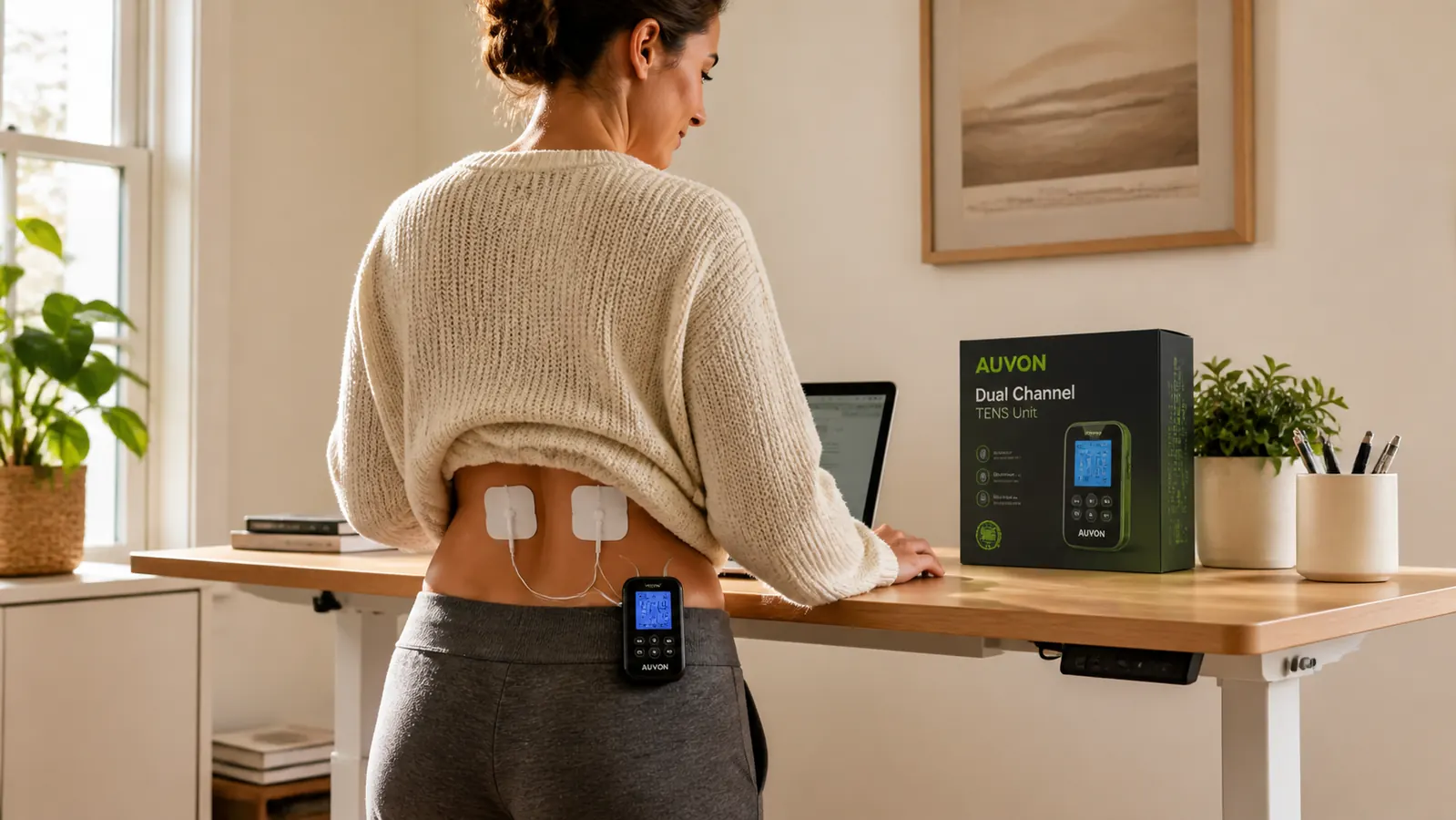
The device lives in my desk drawer. That is not a metaphor, it is a literal description of where it spends most of its time. I work from home, I sit at a desk for six to eight hours a day, and PsA loves sedentary work. My SI joint starts stiffening about two hours in. My right wrist flares whenever I have a heavy typing day. My left shoulder seizes up if I swim two days in a row. The TENS unit addresses all three, just not all at once, unless I use both channels.
My standard routine is TENS first, then movement. I put the pads on, run a 15-minute session at a comfortable intensity, and then get up and do a five-minute stretch or walk. I tried it the other way around early on and it did not work as well. The stimulation seems to lower the pain signal enough that the movement after is much easier to do and less likely to aggravate anything. My rheumatologist did not tell me this. I figured it out by accident.
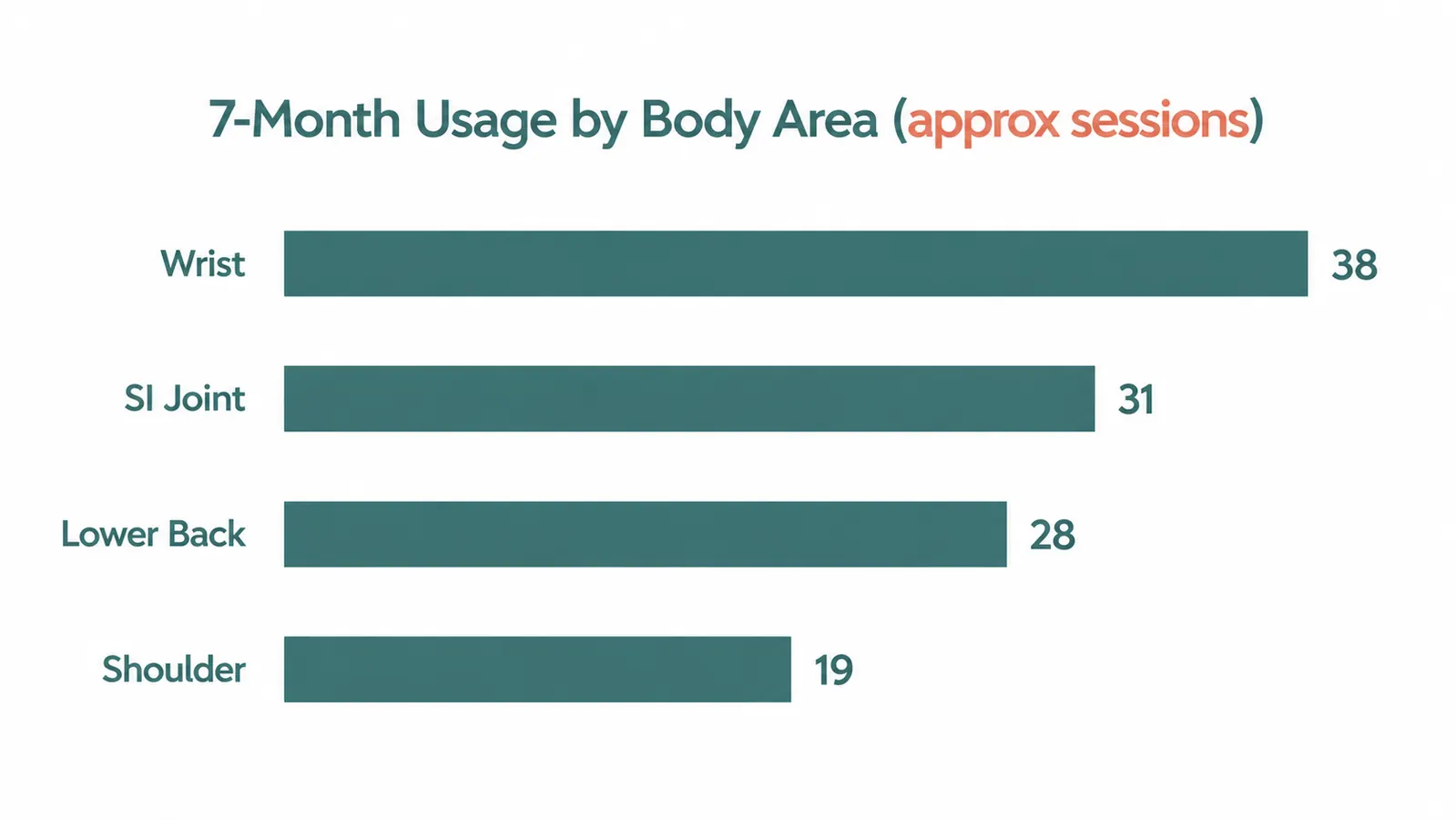
I tracked my usage loosely over the first four months. My wrist got the most sessions by a wide margin because typing flares are the most frequent problem I have. The SI joint came second. Low back third. Shoulder least often because swimming flares are less predictable. Looking back, the chart makes sense: my wrist is the joint that affects my work directly, so it gets priority treatment.
Joint-by-Joint: What Actually Works
The wrist is where I get the most consistent results. I place one pad on the inside of the wrist, one on the outside, and run 15 minutes on the massage mode. Relief is noticeable within a few minutes and lasts about an hour, sometimes two. On a flare day that is enough to get through a writing deadline without reaching for ibuprofen.
The SI joint is trickier to pad. The sweet spot took me a few weeks to find: one pad on each side of the sacrum, slightly above the beltline. The knead mode works better here than massage for reasons I cannot explain clinically. It feels like a deeper pressure rather than a surface buzzing, which is what the SI joint seems to need.
Low back pain from sitting too long responds well to the pulse mode. I use a slightly lower intensity for the low back than I do for the wrist or SI joint because the muscles there are larger and the sensation can get uncomfortable fast if I turn it up too high. Fifteen minutes in pulse mode usually gets me through the second half of a workday without needing to lie down.
The shoulder is the only area where my results are inconsistent. Placement matters enormously with the shoulder because the joint is deep and the pads are sitting on top of muscle and skin. On good days I get solid relief. On bad swimming-flare days, the TENS helps but it is not enough on its own and I usually need Biofreeze as well.
The 24 Modes: What I Actually Use
When I opened the box I saw 24 modes and felt immediately overwhelmed. The instruction booklet is thin and does not explain what each mode is designed for. I spent the first two weeks cycling through everything systematically, which was exhausting. By month two I had settled into four modes: massage, deep tissue, knead, and pulse. I have not touched the other 20 since.
Massage is my go-to for wrist flares. It has a rhythmic on-off pattern that feels closest to actual manual work on a joint. Deep tissue uses a stronger, slower pulse that is better for thick muscle groups like the glutes or upper back. Knead is what I use for the SI joint because it has a rotating-pressure quality. Pulse is the most basic mode and the one I default to when I am not sure what I need, usually late in the day.
The other 20 modes are not useless, they are just redundant for my specific use case. If you have athletic muscle soreness or you are using this for post-workout recovery, you might find more of them useful. For arthritis pain specifically, you will likely settle on three to five favorites within the first month and that is fine.
I went from reaching for ibuprofen four times a week to maybe twice a week. That is not nothing when you are on methotrexate and your GI system is already under pressure.
The Dual-Channel Feature: Why It Actually Matters
Most TENS units in this price range are single channel. That means one output, one body area at a time. The AUVON is dual channel, meaning two completely independent outputs, each with its own intensity control. In practice this means I can treat my left wrist and my right wrist simultaneously, which is useful on symmetrical flare days. Or I can treat my SI joint and my low back at the same time.
The dual-channel setup also means the device ships with 12 pads instead of the 4 that most single-channel units include. Twelve pads sounds like a lot until you use the device regularly. Each pad lasts about 30 uses before the adhesive starts to fail. I got roughly three to four months out of the original set before needing replacements. Replacement pads are available on Amazon for around ten dollars for a pack of 16, so the annual running cost works out to about 45 dollars total including the device itself. That is one co-pay.
Battery Life and Charging After Seven Months
The AUVON is rechargeable via USB, which matters for travel. I charge it once a week on Sunday evenings, and a full charge lasts the entire week of four to five sessions. That works out to roughly ten hours of actual use per charge, which matches what the listing claims. After seven months the battery has not noticeably degraded. It charges from the same cable as my phone, which means I never need to hunt for a special charger.
For travel the unit is TSA-friendly. I have taken it through security at two airports in the past seven months and it went through without incident. It fits in a toiletry bag. The carrying pouch it comes with is not high quality but it keeps the wires from tangling, which is its only real job.
The NSAID Reduction Question
This was the original reason I bought it and it deserves a direct answer. In the seven months I have been using this device, my ibuprofen use has dropped from roughly four times a week to about twice a week. Some of that reduction is the TENS unit. Some of it is seasonal variation in my symptoms. I cannot separate the two perfectly and I am not going to pretend I can.
What I can say is that the TENS unit gives me a real pain management option on methotrexate weekends when I want to avoid stacking too many anti-inflammatory inputs on a single day. My rheumatologist knows I use it and has no objection. It does not interact with any medication I take. For someone living with autoimmune arthritis who is watching their NSAID intake carefully, that is meaningful.
If you want to understand how TENS stacks up against the other go-to tool in most people's drawer, the comparison article on this site about TENS vs heating pads covers the mechanism differences in more detail. They work through different pathways and, for most people, they are complementary rather than competing.
Pros
- Dual channel with two independent intensity controls, rare at this price
- 12 pads included instead of the usual 4, genuinely generous
- Rechargeable via standard USB, no proprietary charger needed
- Battery lasts a full week of 4-5 sessions on a single charge
- Safe to use on methotrexate weekends with no drug interaction concern
- TSA-friendly, fits in a toiletry bag or carry-on
- About 45 dollars total annual cost including replacement pads
Cons
- 24 modes sounds like a feature but is mostly confusing; the manual does not explain what each mode targets
- Pad adhesive starts failing around 30 uses, which means ongoing replacement cost
- Shoulder placement is genuinely tricky and results are less consistent than for flatter joints
- The device display is small and hard to read in bright light
- No companion app or preset programs for specific conditions like arthritis vs muscle soreness
Who This Is For
This device is right for you if you are managing chronic joint pain from an autoimmune condition or early-onset arthritis and you are looking for a drug-free option to use between NSAID doses or on days when you want to give your GI system a break. It is also a strong fit if you have multiple affected joints because the dual-channel design lets you treat two areas at once. If you work from home or have a sedentary job and your joints stiffen through the day, keeping this in a desk drawer is a practical solution. You do not need a diagnosis or a prescription. You buy it, put the pads on, and use it.
Who Should Skip It
TENS units are not appropriate for everyone. If you have a pacemaker or implanted cardiac device, skip this entirely and talk to your cardiologist before using any electrical stimulation device. If you are pregnant, same advice. If your pain is from an undiagnosed source, get a diagnosis first. TENS provides relief but it does not treat the underlying condition, so it is not a substitute for understanding what is actually wrong. If you are looking for something that fixes the inflammation itself, you want to look at supplements or topicals rather than electrical stimulation. The article on this site comparing TENS units to heating pads may help you decide which direction is more useful for your specific situation.
Also worth reading: the honest review of this same device covers the things I wish I had known before I bought it, including pad placement mistakes I made in the first two weeks and the mode I used incorrectly for a month before realizing it was not designed for joint pain at all. That review and this one are written from different angles and together they give a complete picture. You can find it at the link below.
Seven months in, this is still the first thing I reach for on a high-pain workday morning.
The AUVON Dual Channel TENS Unit has been the most consistently useful device I own for managing psoriatic arthritis pain between medication doses. At around 25 dollars with 12 pads included and USB charging, it is one of the few things I would buy again without hesitation. If you are trying to reduce your reliance on daily NSAIDs, this is a practical first step.
Amazon Check Today's Price on Amazon →