
I want to start with the thing every other Biofreeze review glosses over: you will smell like a hospital hallway for at least an hour. Not "a hint of menthol." Not "fresh and invigorating." You will walk into a room and people will ask if you are okay. Your coworkers will think you pulled a muscle moving furniture. Your cat will leave. If you have RA, psoriatic arthritis, lupus, or any condition that keeps you reaching for topical pain relief on a regular basis, you need to know what you are actually signing up for before you squeeze that tube for the first time.
I am 30 years old. I was diagnosed with rheumatoid arthritis at 27 after a year of being told my joint pain was "stress-related" and that I was "too young for arthritis." I have been using Biofreeze Pain Relief Cream on and off for about 18 months, primarily on my wrists, knuckles, and right shoulder. This review is not about athletic recovery or post-workout soreness. It is about what a counterirritant menthol cream actually does, and does not do, when your pain is inflammatory, chronic, and driven by your own immune system attacking your joints.
Quick Verdict
Useful, specific, and genuinely better than the generic store version, but only if you understand what you are buying: a 3-to-4-hour distraction from pain, not a treatment. Know the limitations before your first tube.
Amazon Check Today's Price →Still maxed out on NSAIDs and need something for the next few hours?
Biofreeze is a real option for breakthrough flare moments when you cannot take more anti-inflammatories. It will not fix the flare, but it will give your nervous system something else to pay attention to for a while.
Amazon Check Today's Price on Amazon →What Biofreeze Actually Is (And It Is Not What the Label Implies)
The label says "pain relief." That phrase does a lot of heavy lifting. Biofreeze is a counterirritant, which means it works by creating a new, competing sensation (cooling from menthol) that travels along the same nerve pathways as your pain signal. Your brain receives the cooling signal and partially suppresses the pain signal. This is called the gate control theory of pain. The effect is real. But it is not the same as reducing inflammation, blocking prostaglandins, or doing anything at the site of joint damage. The menthol is not soaking into your synovial fluid. Nothing in that cream is addressing what RA or PsA is doing at the cellular level.
That distinction matters because a lot of people with autoimmune arthritis are looking for "something that actually helps," and Biofreeze can feel like that, especially in the first 20 minutes when the cooling effect is strongest. But if you go in expecting an anti-inflammatory or something comparable to Voltaren (which contains diclofenac, an actual NSAID), you will eventually be disappointed. Go in expecting a few hours of reduced pain perception, and it will do exactly what it promises.
The Smell: Let's Just Talk About It
Biofreeze contains 4% menthol as the active ingredient. That is a meaningful concentration. The gel base amplifies the volatility, which means the scent disperses aggressively into the air around you. Within two minutes of application you will smell it. Within five minutes, anyone within 10 feet of you will smell it. Within 15 minutes, a closed room will smell like it. This is not a small inconvenience if you are applying it before work, before a meeting, in a shared apartment, or anywhere you cannot immediately open a window.
I have applied it on the train. I have applied it in a restroom stall at work. I have applied it in the car before school pickup. Each time I felt it was warranted, and each time I fielded at least one "are you okay?" from someone nearby. If the smell is a dealbreaker for you, Voltaren (diclofenac gel) is nearly odorless and works through a different mechanism. See our comparison of Biofreeze vs Voltaren for arthritis pain for a side-by-side breakdown. But if you can tolerate the smell, or if you are applying before bed, at home, or somewhere else where it does not matter, this is a nonissue. You get used to it. Mostly.
Duration Is 3 to 4 Hours, Not 'All Day'
The packaging uses phrases like "fast-acting relief" and does not make explicit duration claims in a way that commits to a number. What I have found, consistently over 18 months of use, is that the meaningful cooling effect lasts roughly 90 minutes to two hours. A residual sensation, just enough to notice, lingers until about the three-to-four-hour mark. After that, it is gone. Your joint pain returns to wherever it was. If you are managing chronic arthritis pain through a full workday, that math does not work unless you reapply, and reapplying at work means the smell problem starts all over again.
For breakthrough flare moments, this duration is usually enough. If you wake up at 3 a.m. with your wrist aching and you cannot take more medication, a 3-to-4-hour window gets you back to sleep. If you have an important meeting at 10 a.m. and your hands are bad, applying at 9:45 gives you a usable window. You plan around it. That is how most people with chronic pain use Biofreeze effectively: strategically, not continuously.
Biofreeze is not a treatment. It is a few hours of your nervous system paying attention to something other than your joint. That is still genuinely useful, as long as you know what it is.
Four Things That Go Wrong (That Nobody Puts in Reviews)
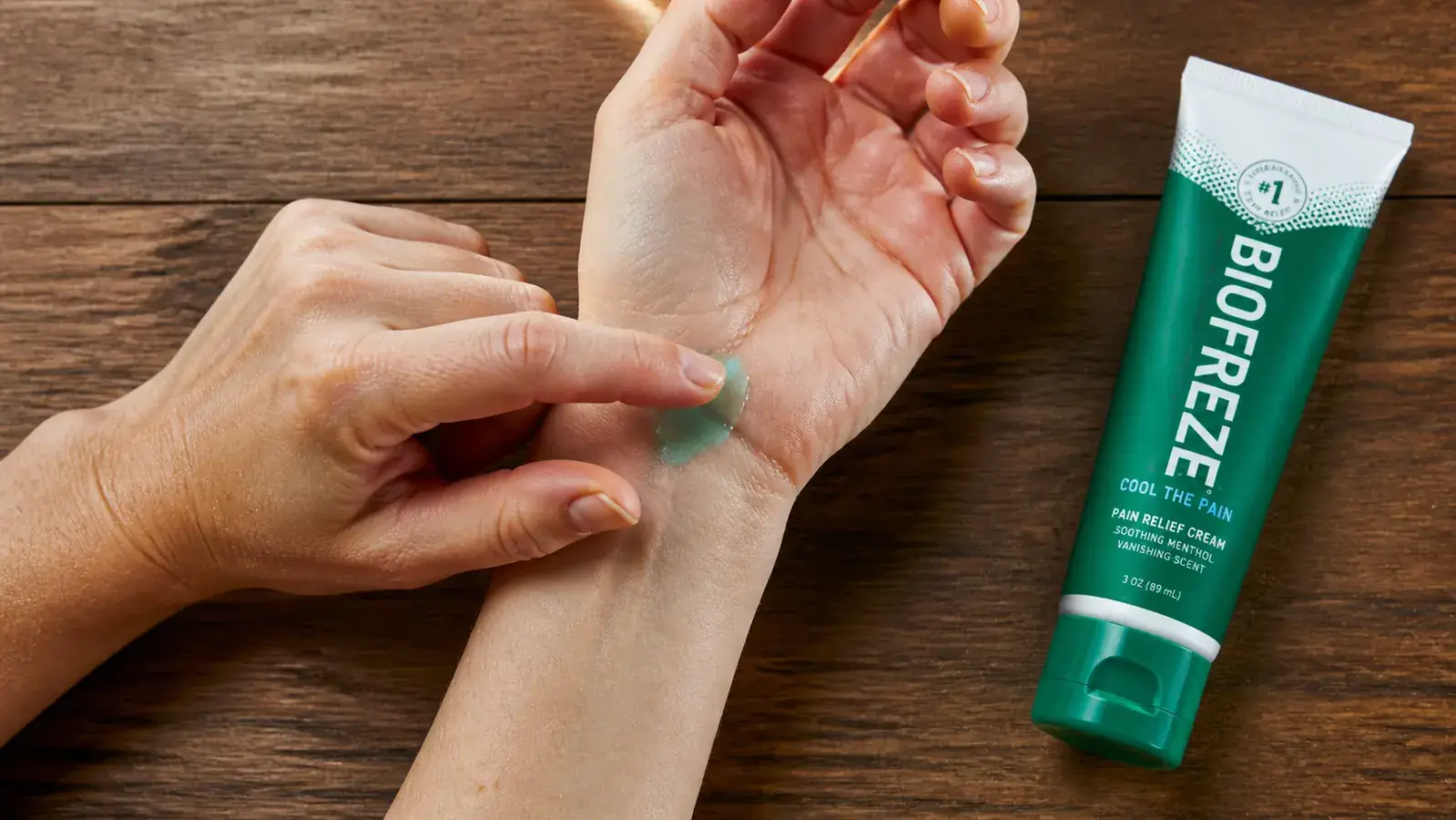
The application problem is real and underreported. Biofreeze is a cream. You apply it with your hands. Your hands then have menthol on them at concentration levels high enough to cause significant discomfort if they contact your eyes, your lips, or any mucous membrane. Wash your hands thoroughly with soap and water immediately after application, not a quick rinse. If you have RA with significant hand involvement and washing your hands is already uncomfortable, this is an actual barrier to using the product. You can use a glove, a cotton ball, or the pump dispenser version if you need hands-free control, but the 3oz cream tube you get on Amazon requires direct contact with your fingers.
Hot showers after application can be dangerous. Menthol numbs the skin's temperature perception in the area where it is applied. If you apply Biofreeze to your shoulder and then step into a hot shower, the skin on your shoulder will not accurately register the water temperature. Scalds on already-inflamed skin are not something you want to find out about the hard way. Wait at least 45 minutes after a Biofreeze application before getting into a hot shower. Alternatively, apply after your shower, not before.
Sweating reactivates the menthol. If you use Biofreeze before low-intensity exercise and then start sweating, the moisture reactivates the cooling compounds and you will feel a fresh wave of intense cold in the area. This is startling the first time it happens. At the gym it is more strange than dangerous, but if you are doing physical therapy, a yoga class, or any kind of moderate movement, expect this to happen around the 20-to-30-minute mark. Some people find it useful. Some find it disorienting. You should expect it either way.
Do not combine Biofreeze with a TENS unit on the same spot. The cream creates a greasy residue on the skin. TENS electrode pads need clean, dry skin to adhere properly and conduct current evenly. If you apply Biofreeze and then try to attach a TENS pad over the same area, the pad will either not stick or will peel off mid-session. Worse, uneven adhesion can concentrate the electrical current and cause a mild burn. If you want to use both modalities in the same session, apply them to different locations. Use Biofreeze on the joint that is most painful and the TENS pads on the surrounding muscle if that makes anatomical sense, or alternate the two tools across sessions rather than combining them on the same spot.
Skin Reactions: Rare, but Real
A small percentage of users develop contact dermatitis from menthol or from one of the inactive ingredients in Biofreeze (which includes carbomer, triethanolamine, and FD&C Blue 1, the dye that gives it the green color). The reaction looks like redness, small hives, or itching that persists after the cooling sensation fades. It is not the same as the normal cooling sensation, which feels cold and fades cleanly.
If you have skin that already reacts to fragrances or topical products (common in people with autoimmune conditions), do a patch test on the inside of your elbow before your first full application. Apply a small amount, wait 30 minutes, and check for redness or itching. If you react to the patch test, skip this product. For the majority of users, no skin reaction occurs, but it is worth a 30-minute check before you apply it across your shoulder blades and then sit on a plane for two hours.
Is Biofreeze Worth the Price vs Generic Menthol Creams?
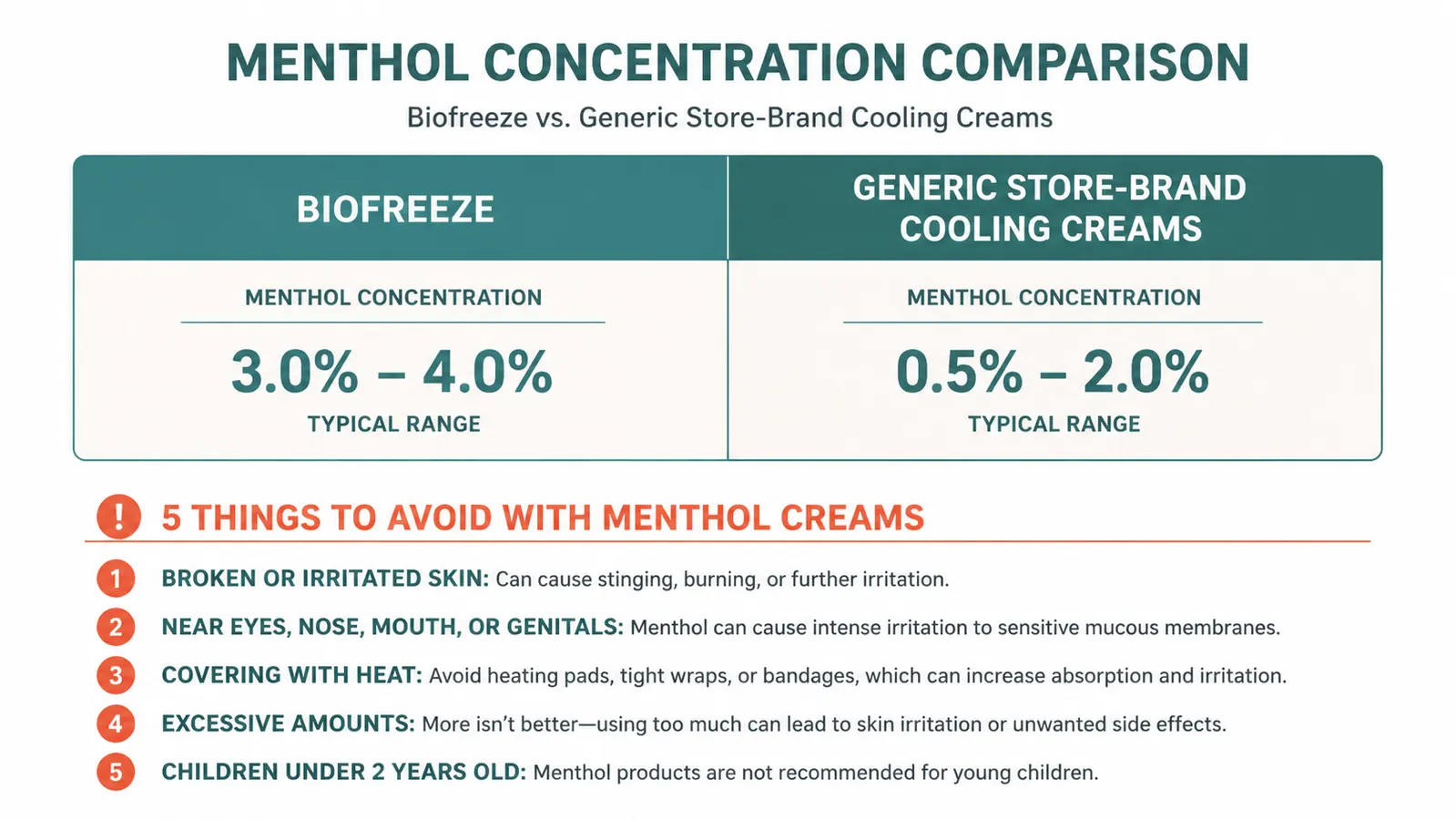
Biofreeze is not cheap compared to the menthol creams at a CVS house brand or dollar store. Those products are typically 0.5% to 1% menthol in a thicker, greasier base. Biofreeze is 4% menthol in a lighter, water-soluble gel base. The concentration difference matters. At 1%, you feel a mild cooling. At 4%, you feel your skin actually go cold and the pain signal genuinely interrupts. The gel base also absorbs faster and leaves less residue, which matters for applying it before you get dressed.
The pharmacy store-brand alternatives are tempting because they look almost identical on the shelf. The ingredients list is usually where they fall apart. Lower active ingredient percentage, heavier petrolatum-based carriers that trap the menthol against the skin without letting it absorb, and inconsistent quality across batches. I have tried three different store-brand alternatives over the past 18 months and none of them produced the same intensity of cooling or the same clean-wearing finish as Biofreeze. The cost-per-ounce is higher for Biofreeze, but it is the only version where I reliably felt the product do what I needed it to do.
Pros
- 4% menthol concentration is meaningfully stronger than most generic alternatives
- Gel base absorbs faster and leaves less residue than petroleum-based knockoffs
- Real, noticeable interruption of pain signals for 3 to 4 hours
- No systemic absorption, no drug interactions, safe to use when you are already at your NSAID ceiling
- Works specifically well for breakthrough flare moments at night or before specific tasks
Cons
- Intense menthol smell that lingers for an hour or more, detectable by everyone nearby
- Relief lasts 3 to 4 hours, not all day, requires strategic reapplication
- Hands must be washed thoroughly after application, a real friction point with RA hand involvement
- Cannot be combined with TENS electrode pads on the same skin area
- Hot showers after application carry a mild scald risk due to numbed temperature perception
- Small percentage of users get contact dermatitis, patch test recommended
- Sweating mid-exercise reactivates cooling, which can be disorienting
- Does not address inflammation at all, it is a counterirritant only
What This Actually Means If You Have Inflammatory Arthritis
If you have RA, psoriatic arthritis, lupus with joint involvement, or a similar autoimmune condition, you are presumably already working with a rheumatologist and taking some combination of DMARDs, biologics, or conventional NSAIDs. Biofreeze does not belong in the same conversation as methotrexate or a biologic. It does not suppress the immune response. It does not protect your joints. It does not change disease progression in any direction. If you are reading this hoping to find a topical that replaces your prescription protocol, this is not it.
Where it earns a place in a young chronic pain patient's toolkit is the specific scenario where you have already taken your maximum daily NSAID dose, you have a flare hitting at an inconvenient time, and you need functional relief for the next three hours. That situation happens more than any of us would like. In that context, something that works through a completely separate mechanism and carries zero drug interaction risk is genuinely useful. It is also useful for the half-awake 4 a.m. version of yourself who just wants to get back to sleep without thinking about dosing schedules.
The strongest case for Biofreeze over generic alternatives is exactly this scenario. When you need it, you want it to actually work. The 4% formulation in the gel base works. The 0.5% store-brand in the thick petroleum base does not produce the same result. For this specific use case, the price difference is justified.
Who This Is For
Biofreeze is the right product if you have a specific, recurring need for a few hours of topical pain relief and you are not combining it with hot showers or TENS units in the same session. It works well for people who already have a prescription pain management plan in place and need a non-pharmacological option for the gaps. It works well for pre-sleep application when you are too tired to think about drug interactions. It works particularly well if you apply it before low-stakes tasks, a short walk, a gentle stretch session, or getting through a difficult morning, where you just need the pain quiet enough to function.
Who Should Skip It
Skip Biofreeze if the smell is genuinely not manageable for your life. Skip it if you have sensitive skin that reacts to fragrances or topical products without doing the patch test first. Skip it if you are hoping it will work the way Voltaren works (as an actual anti-inflammatory) because that is a different mechanism and a different product. Skip it if your primary pain management involves a TENS unit, since the two cannot practically be used together on the same area. And skip it if you have read this review and decided you want something that lasts longer, because nothing in the menthol counterirritant category is going to give you all-day relief. That is the honest answer.
Know the limitations, and it is still worth having in the cabinet
Biofreeze Pain Relief Cream is the strongest menthol formulation you can buy over the counter without a prescription. For breakthrough flare moments when your NSAIDs are capped and you need a few hours of quiet, it genuinely delivers. Just wash your hands after, skip the hot shower, and do not use it on the same spot as your TENS pads.
Amazon Check Today's Price on Amazon →If you want to compare Biofreeze against Voltaren diclofenac gel, which uses a fundamentally different mechanism and carries its own set of tradeoffs, see our head-to-head at Biofreeze vs Voltaren for arthritis pain. If you have already decided Biofreeze is the right fit and want to know how to get the most out of each application, our long-term use review at Biofreeze Pain Relief Cream for Rheumatoid Arthritis walks through five months of daily use in detail.