
I was 29 when my rheumatologist added methotrexate to my RA protocol and said, almost as an aside, "Be careful with topical NSAIDs." I had been using Voltaren on my knee for months. Nobody had flagged it. I switched to Biofreeze the next week and honestly never went back, not because Voltaren is bad, but because the risk math changed the moment I was on a disease-modifying drug. If you are young, on an autoimmune medication, and trying to figure out which topical actually belongs in your bathroom cabinet, this is the comparison I wish someone had written for me.
The short answer: Biofreeze wins for anyone managing active inflammatory arthritis, especially if you are already on methotrexate, a JAK inhibitor, or a biologic. Voltaren has a real place for steady-state osteoarthritis pain where systemic NSAID risk is low. But if your arthritis comes with a prescription drug stack, the mechanism differences here matter.
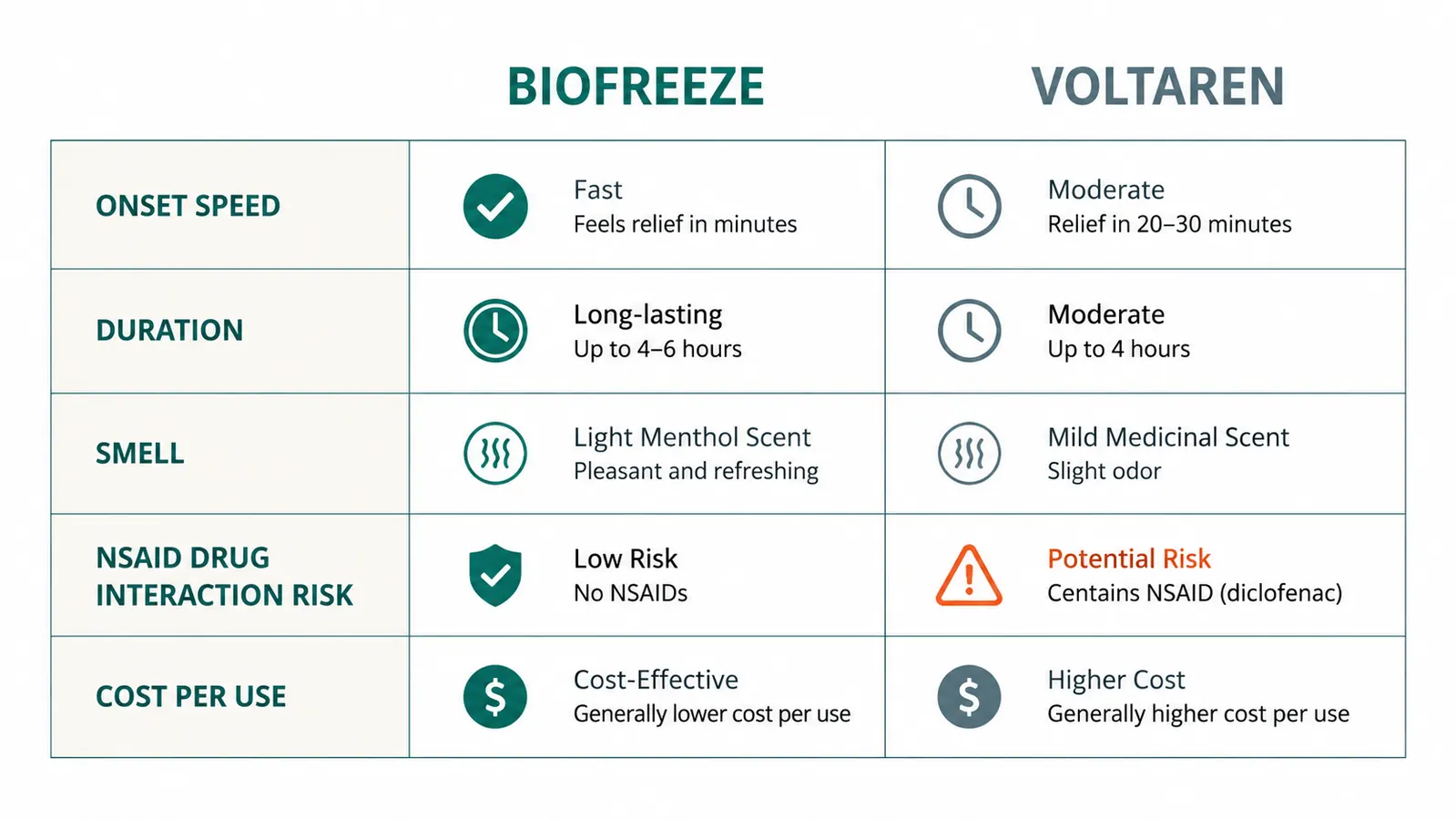
| Category | Biofreeze (Menthol) | Voltaren (Diclofenac) |
|---|---|---|
| Mechanism | Counterirritant: menthol activates cold-sensing nerve receptors (TRPM8) to interrupt pain signals | Topical NSAID: diclofenac absorbs through skin and inhibits COX-1/COX-2 enzymes at the joint |
| Onset Speed | 2 to 3 minutes | 30 to 60 minutes |
| Duration of Relief | Roughly 4 hours | 6 to 8 hours per application |
| Smell | Strong menthol, noticeable in a room | Very mild, nearly odorless |
| Drug Interaction Risk | None significant. No systemic absorption. Safe alongside methotrexate, biologics, JAK inhibitors | Carries standard NSAID warnings. Can elevate methotrexate levels in blood. Potential GI, kidney, and cardiovascular risk stacking |
| Prescription Required | No | No (OTC since 2020) |
| Compatible With TENS Unit | Yes, remove cream before pad placement | Not recommended under electrode pads |
| Cost Per Use (approx.) | Lower cost per application from a 3 oz tube | Higher cost per application |
| Best Use Case | Acute flares, morning stiffness, pre-activity, breakthrough pain | Daily preventative use for chronic OA in a single joint (knee, hand) with no NSAID medication conflict |
Still reaching for Voltaren while on methotrexate? Here is a safer option for flare days.
Biofreeze uses menthol, not an NSAID. No drug interactions, no GI stacking risk, and it works in about 2 minutes. Rated 4.6 stars across 15,000+ reviews.
Amazon Check Today's Price on Amazon → →How They Actually Work (The Mechanism Matters More Than You Think)
Biofreeze is a counterirritant. The active ingredient, menthol, binds to TRPM8 receptors in the skin. These are the same receptors that tell your brain something cold is happening. That signal competes with your pain signal on the way to your brain, and the cold wins. It is not reducing inflammation at the tissue level. It is interrupting how your nervous system processes the pain. That is why it works in minutes and wears off in a few hours.
Voltaren works completely differently. It contains diclofenac sodium, a nonsteroidal anti-inflammatory drug. When you apply it, some of that diclofenac does penetrate through the skin and accumulate in the joint tissue beneath. It then inhibits COX-1 and COX-2 enzymes, slowing the production of prostaglandins, which are part of the inflammatory cascade. This takes longer to kick in, but it is doing something Biofreeze cannot: modulating the inflammatory process itself, at least locally.
Neither approach is fake. They are just built for different jobs. Biofreeze is a fast interruptor. Voltaren is a slower, more targeted suppressor. Understanding that difference is the key to using either one well.
Where Biofreeze Wins
For anyone managing autoimmune arthritis (RA, psoriatic arthritis, lupus-related joint involvement, ankylosing spondylitis), Biofreeze's biggest advantage is not speed, though two to three minutes of onset is genuinely useful when you wake up unable to close your hand. The biggest advantage is that it carries no systemic NSAID risk at all. Menthol does not absorb into your bloodstream in meaningful amounts. It does not interact with methotrexate. It does not compete with your liver enzymes the way oral or transdermal NSAIDs can. If you are on a biologic, you are already accepting enough immunological complexity. Adding a topical NSAID that can raise methotrexate plasma levels is not a trade-off worth making when a menthol cream does a credible job on acute pain.
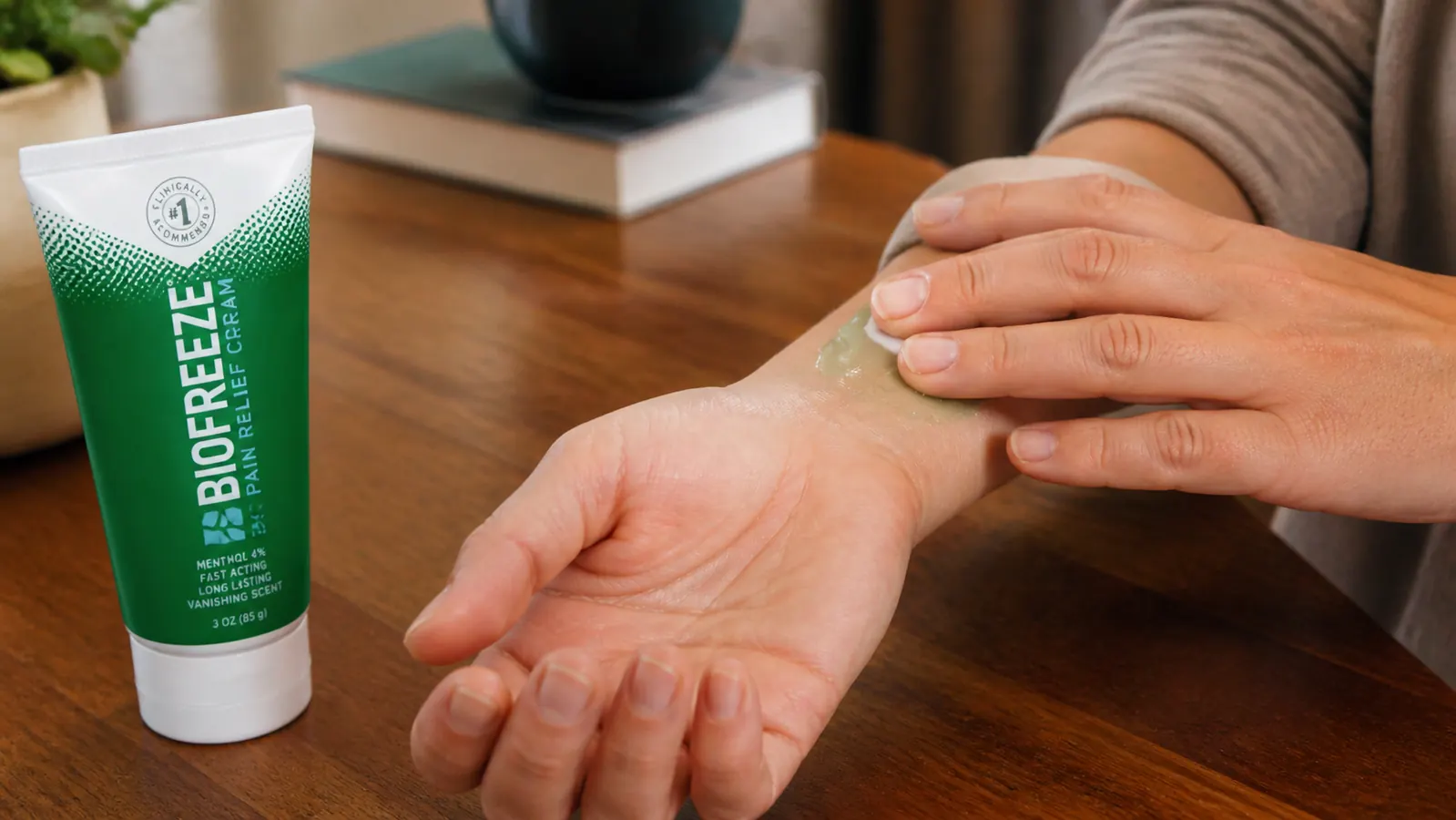
Biofreeze is also sports tape compatible, which matters if you use kinesiology tape on a swollen joint or knee. You can apply and let it dry before taping. It pairs well with TENS unit sessions too, as long as you clean the skin before placing electrode pads. For flare management throughout a workday, the ability to reapply every four hours without worrying about cumulative NSAID exposure is a meaningful quality-of-life advantage.
The moment my rheumatologist said methotrexate, the risk math on Voltaren changed. Biofreeze does not touch that equation. That is why it lives on my bathroom counter now.
Where Voltaren Wins
Voltaren earns its reputation for a specific patient: someone with a single bad osteoarthritic joint, not on any NSAID-interacting medication, who wants longer-lasting daily pain management rather than quick breakthrough relief. A 65-year-old with isolated knee OA using no other anti-inflammatory drugs is a reasonable Voltaren candidate. The longer duration of six to eight hours per application is genuinely useful for steady-state pain, and the odorless gel is more practical for daytime wear when Biofreeze's menthol smell would be noticeable at work or in meetings.
Voltaren also has a more robust clinical evidence base for osteoarthritis specifically. Multiple randomized trials have shown meaningful pain reduction for hand and knee OA with topical diclofenac. If your pain is structural OA with a low systemic drug burden, that evidence is worth considering. The caveat for younger readers: if you are in your 20s or 30s with inflammatory arthritis and you are already taking anything in the NSAID or DMARD family, those trial populations were not you.
The Drug Interaction Issue Nobody Talks About
This is the part that gets skipped in most Biofreeze vs Voltaren articles, probably because most of those articles were written for a generic pain audience. But if you are reading this site, there is a real chance you are on methotrexate, a biologic like adalimumab or etanercept, or a JAK inhibitor. This changes the picture.
Methotrexate is primarily cleared by the kidneys. NSAIDs, including topical diclofenac with percutaneous absorption, can reduce renal clearance of methotrexate, which means the drug stays in your system longer at higher concentrations. This interaction is well-documented for oral NSAIDs and is clinically relevant even at low doses. Topical application reduces systemic exposure compared to oral NSAIDs, but it does not eliminate it. The FDA label for Voltaren specifically lists renal function and drug interactions as things to discuss with your prescriber. If your rheumatologist manages your NSAID use carefully already, adding a topical NSAID without flagging it is a real oversight.
Biofreeze carries none of this. Menthol has no documented interaction with methotrexate, biologics, or JAK inhibitors. For a population where the medication stack is already complex, that clean safety profile is not a small thing.
Onset, Duration, and the Flare Reality
When a flare hits, you do not have 45 minutes to wait. I know this from a specific Tuesday morning in January 2024 when my right wrist locked up before I could get dressed for work. Biofreeze was on in 90 seconds and doing something useful by minute three. Voltaren on that same joint would have taken the better part of an hour to reach meaningful tissue concentration. For acute breakthrough pain, the two-to-three minute onset is not a minor feature. It is the feature.
Voltaren's longer duration does matter for chronic steady-state pain. Four hours versus six to eight hours is a real difference if you are applying throughout a workday. But for most autoimmune arthritis patients, the pain pattern is less about steady chronic ache and more about flares and unpredictable spikes layered on top of baseline symptoms. Biofreeze's shorter duration is a reasonable trade for its faster onset and safer medication profile when your pain is that variable.
Smell, Cost, and the Practical Day-to-Day Stuff
Biofreeze smells like menthol. If you are applying it at your desk before a video call, people will notice. Voltaren is nearly odorless, which makes it easier to use discreetly during the workday. If smell is a dealbreaker in your environment, that is a legitimate point in Voltaren's favor and you should factor it in.
On cost, Biofreeze is consistently cheaper per ounce and per application. A 3 oz tube at current pricing covers about 20 to 30 applications depending on how generously you apply. Voltaren's equivalent applications run higher. For people managing pain daily across multiple joints, that price difference accumulates over months.
Who Should Buy Which
Buy Biofreeze if: you have RA, psoriatic arthritis, lupus joint involvement, EDS, ankylosing spondylitis, or any inflammatory arthritis driven by an autoimmune condition. Buy it if you are on methotrexate, any biologic, or a JAK inhibitor. Buy it if your pain is flare-pattern rather than steady-state. Buy it if you use sports tape or a TENS unit. Buy it if you need something that works in two minutes, not forty-five. Buy it if cost matters and you are applying multiple times a day.
Consider Voltaren if: your arthritis is isolated OA in one or two joints, you are not on methotrexate or any NSAID-interacting medication, your prescriber has reviewed your full drug list and specifically said topical NSAIDs are fine, your pain is steady-state rather than flare-based, and odorless application during the workday is important to you. Even then, tell your doctor you are using it.
Pros
- Works in 2 to 3 minutes, genuinely useful for acute flare moments
- No systemic NSAID absorption, no interaction with methotrexate or biologics
- Lower cost per application than Voltaren
- Compatible with sports tape and TENS unit sessions
- Safe to reapply every 4 hours without cumulative drug risk
- 4.6 stars across 15,000+ real reviews
Cons
- Strong menthol smell, noticeable in meetings or shared spaces
- Relief lasts roughly 4 hours, shorter than Voltaren's 6 to 8
- Does not reduce local inflammation at the tissue level, only interrupts pain signaling
- Not the right tool for steady-state structural OA if NSAID interaction is not a concern
Fast onset, no NSAID risk, works alongside your RA meds.
Biofreeze is what I reach for during a flare and before any activity that stresses my joints. No interaction with methotrexate. No smell warnings for your colleagues, well, fewer warnings. Check current pricing on Amazon.
Amazon Check Today's Price on Amazon → →The Bottom Line
Voltaren is not a bad product. For the right patient, isolated OA, no drug interactions, steady-state pain, it does what it says. But the right patient for Voltaren is largely not the audience for this site. If you are in your 20s or 30s or 40s managing autoimmune arthritis on a real medication protocol, Biofreeze is the smarter daily companion. It is faster for flares, cheaper over time, and it does not add a second layer of NSAID exposure on top of a medication stack that is already doing complex work.
Neither of these is a substitute for your rheumatologist's treatment plan. But as an adjunct for breakthrough pain, morning stiffness, and the moments between doses of your actual medications, Biofreeze earns its spot. It has earned mine.