

I was 28 when my rheumatologist confirmed what I had suspected for two years: rheumatoid arthritis, with primary involvement in my hands and wrists. My knuckles would swell overnight and my fingers would be so stiff by morning that I could not make a fist until nearly 10 a.m. I was a full-time remote worker doing eight to nine hours of typing a day. The timing felt cruel. Within a few months of my diagnosis, I started reading everything I could about compression gloves. I ordered the Vive Compression Arthritis Gloves in February of last year. I am now on my second pair and my fourth month of owning two pairs at once. This review covers what happened between then and now.
This is the long-term daily-use review. If you want the sharper, more critical take on what these gloves do not do and who should look elsewhere, that is covered in my companion piece on these same gloves. This one is about living with them for nine months straight: the timeline, the routines that evolved around them, and the specific moments when they made a real difference.
Quick Verdict
Nine months in, these are still the first thing I put on in the morning. At a low per-pair cost, they are the most cost-effective daily tool in my RA kit.
Amazon Check Today's Price →If morning hand stiffness is your daily starting point, these gloves belong on your shortlist.
The Vive open-finger arthritis gloves are budget-friendly. They are HSA and FSA eligible. Most people with RA hands order two pairs within the first month.
Amazon Check Today's Price on Amazon →How I've Used Them: The 9-Month Timeline
The first week was awkward. I put them on at 6:30 a.m. when I woke up and wore them until the stiffness broke, usually around 8:30. That was the original plan: wear them just for morning stiffness, take them off, get on with the day. That lasted about two weeks.
By month two I was wearing them through my entire morning work block. My typing speed barely dropped with the open fingers, and the compression actually made long sessions more bearable rather than worse. By month three, I had stopped thinking about them entirely. There was a Tuesday in April when I finished a three-hour writing sprint and looked down and was mildly surprised to see I was still wearing them. That was the first time I understood what other reviewers meant when they said you forget you have them on. That moment is a real threshold, and it takes a few weeks to reach it.
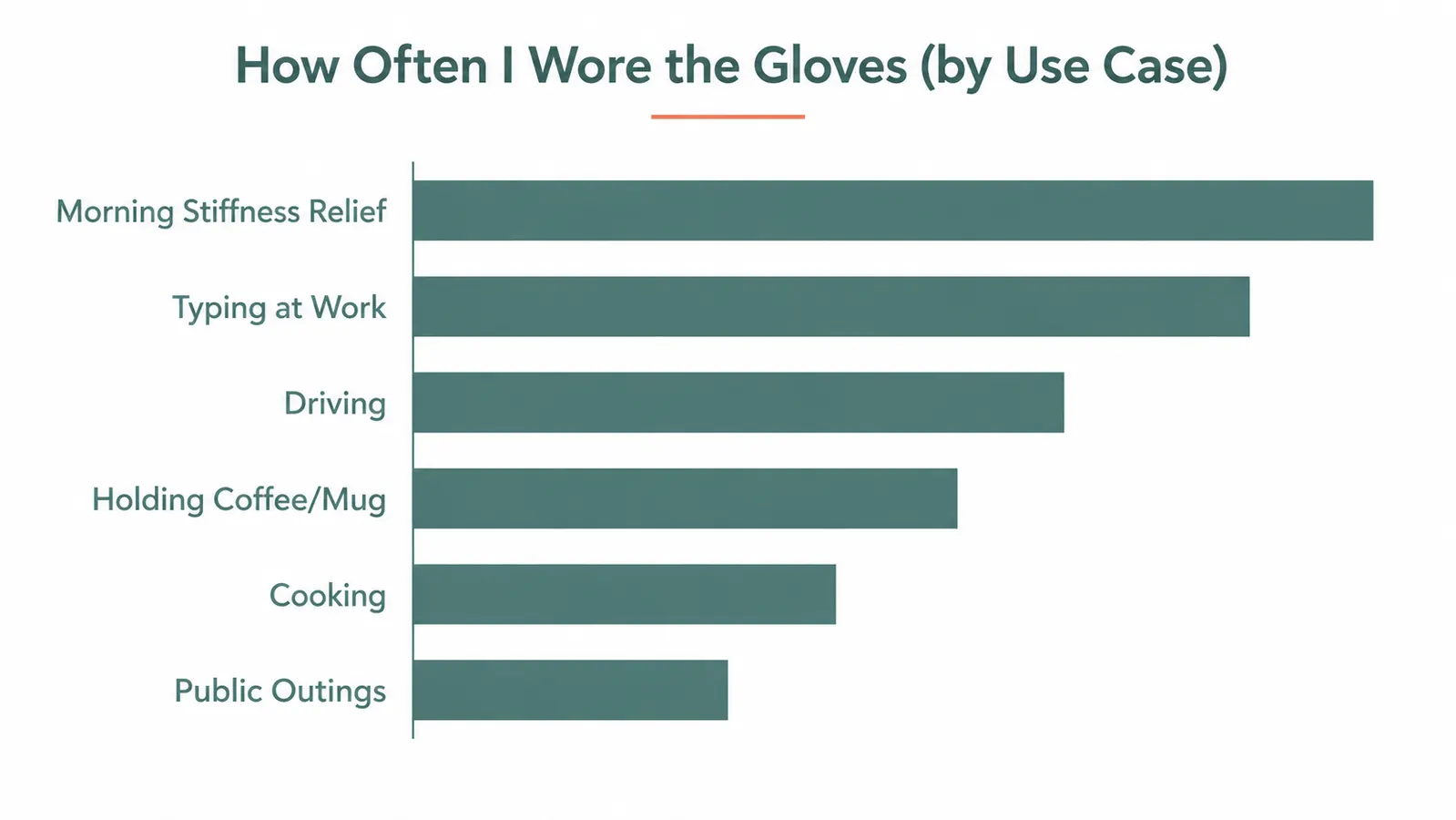
By month four, I was wearing them for specific tasks throughout the whole day: morning wake-up compression, typing through my work hours, gripping the steering wheel on the drive to pick up my nephew, holding a coffee mug with both hands while I read in the evenings. The use cases multiplied on their own. I was not forcing it. The gloves just started fitting into ordinary moments where my hands would otherwise feel unreliable.
The Two-Pair System (And Why It Matters)
I ordered a second pair at the end of month two, and I want to be direct about why: one pair is not enough if you actually want to build a daily habit with these. You are going to wear them, sweat in them at least a little, and need to wash them regularly. If you only have one pair and they are in the wash, you skip a day. Then you skip another day because they are still damp. Then the habit breaks.
Two pairs solve this completely. One is clean and ready, one is in the laundry cycle. At a low per-pair price, two pairs cost very little total. I have now been running this two-pair system for seven months and I have not missed a morning because of laundry once. If you order one pair and you find yourself liking them, just go ahead and order a second one immediately. Do not wait until you realize you need it.
Specific Use Cases That Surprised Me
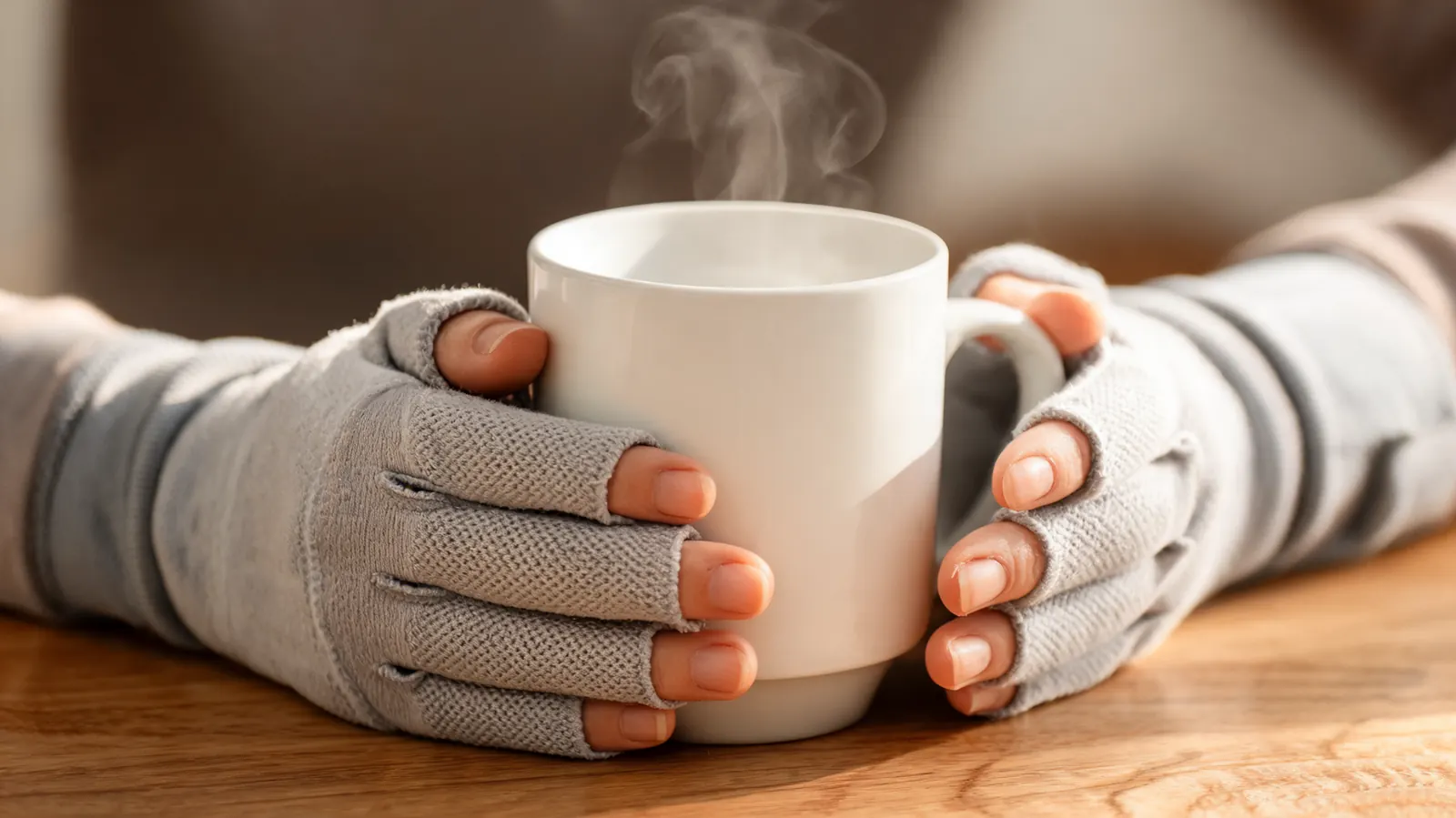
Typing was the obvious use case, but a few others caught me off guard. Holding a coffee mug: when my knuckles are swollen, the pressure of gripping anything cylindrical and warm is uncomfortable in a specific, deep way that is hard to explain. With the gloves on, the sustained gentle compression around those joints meant I could hold my mug without repositioning it every thirty seconds. It sounds like a small thing. It is not small at 7 in the morning when you just want to sit and drink your coffee.
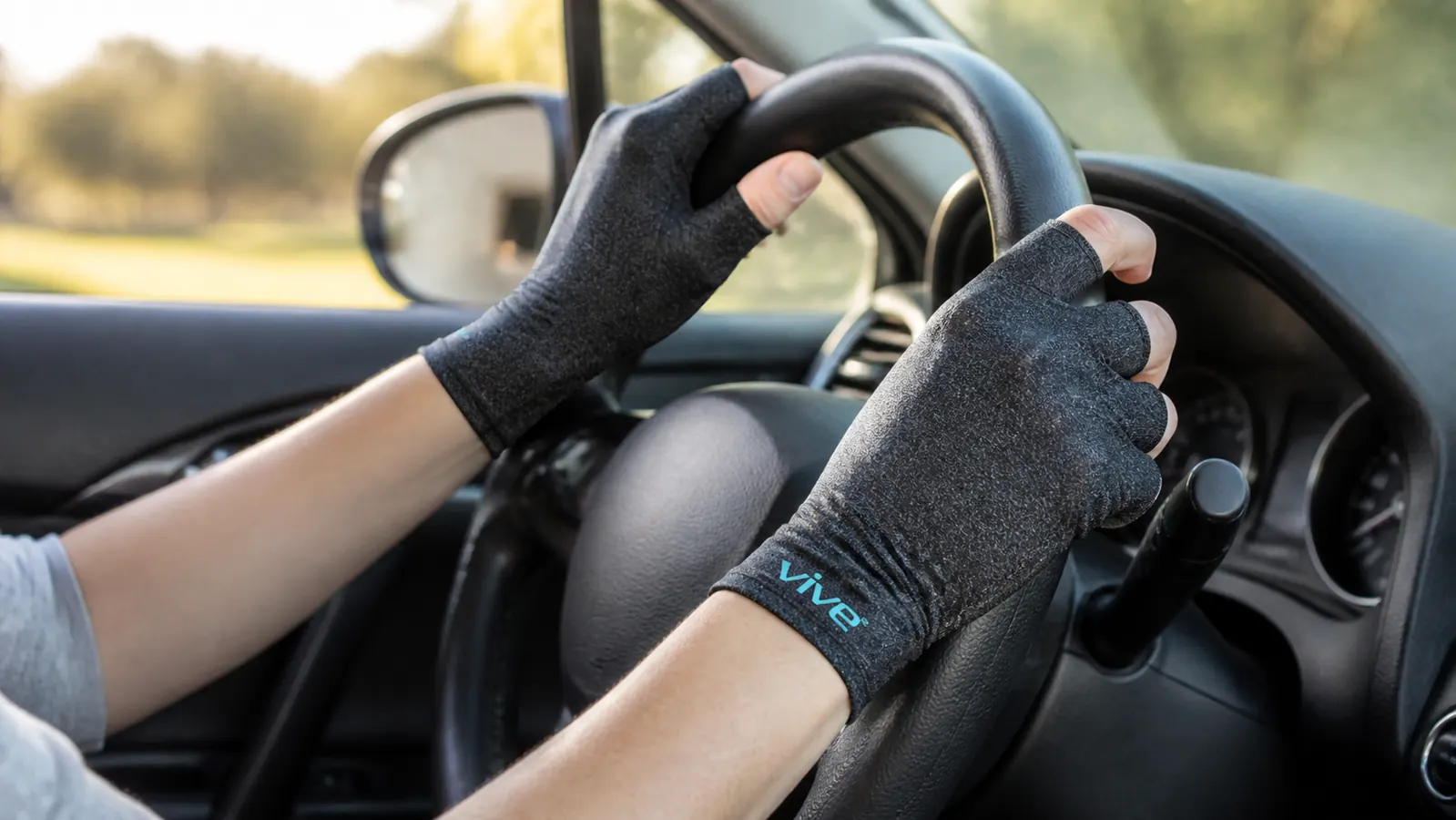
Gripping the steering wheel was another one. I drive a manual car. Shifting gears involves a grip-and-twist motion that my right hand fights me on during a flare. During my commute weeks, I wore the gloves for the full drive. The compression did not take the pain away entirely, but it reduced the sharpness enough that I could concentrate on the road rather than on my hand.
Signing receipts and using a pen in public: this one is about more than pain. When your handwriting deteriorates because your fingers are swollen, there is a social discomfort that layers on top of the physical discomfort. The gloves help with the physical part, which indirectly makes the social part less fraught. I stopped dreading signing things.
The Winter Morning Bonus
I work from home, and my apartment runs cold in the mornings from November through March. Cold hands and RA hands are a particularly bad combination: cold stiffens everything faster and makes the morning window of stiffness longer. What I noticed around month five was that the gloves were doing double duty in winter. The light compression was providing warmth as well as joint support. My fingers stayed warmer than they would have bare, which I believe shortened my morning stiffness window by maybe twenty to thirty minutes on cold days. This is not something I can measure precisely, but it was consistent enough that I noticed it every time I accidentally skipped the gloves on a cold morning.
If you work from home in a cold space, this alone justifies ordering a pair before winter arrives. The warming effect is a side benefit, not the purpose of the gloves, but it is real and it matters.
By month three, I finished a three-hour writing sprint, looked down, and was surprised to see I was still wearing them. The invisibility threshold is real, and it takes a few weeks to reach it.
Pairing With Biofreeze: A Protocol Worth Knowing
Around month five I started experimenting with applying a small amount of Biofreeze to my knuckles before putting the gloves on. The logic is straightforward: the menthol in Biofreeze penetrates the skin and provides a cooling analgesic effect. The compression gloves then hold the product against the skin and slow its evaporation, which extends the active period. If you have ever noticed that Biofreeze wears off in twenty or thirty minutes on bare skin, this combination makes it last meaningfully longer.
I use a thin layer on the knuckles and the back of my hands only, not the palms, and put the gloves on immediately after. This is now my standard morning flare protocol. I cover Biofreeze in depth in a separate review if you want the full picture on that product, but the short version is that it and the gloves work better together than either one does alone. For the full guide on using topicals with compression, see my piece on Biofreeze for rheumatoid arthritis pain.
Wearing Them in Public: The Dignity Factor
I want to be honest about something that does not show up in Amazon reviews very often: the first two weeks I wore these in public, I was self-conscious. I am 30. Compression gloves have an association with much older patients, and I was aware of that every time someone glanced at my hands at the coffee shop or in a meeting. I considered taking them off before leaving the house more than once.
By week three, that feeling was almost gone. What replaced it was a kind of quiet pragmatism. The gloves are visually subtle. Most people do not notice them, and the ones who do usually assume I am cold or that they are some kind of tech wearable. I stopped narrating their presence to myself and started thinking of them the way I think of my glasses: a tool I put on in the morning because I need it, full stop.
If you are in your 20s or 30s and hesitating because of how these look in public, give it three weeks. The self-consciousness does wear off, and the relief they provide is worth the adjustment period. For more on the comparison between gloves and more visible alternatives, my breakdown of compression gloves vs hand splints for RA covers that tradeoff directly.
Sleeping in Them and the Travel Question
On sleeping: I have tried it, I have discussed it with my occupational therapist, and my honest answer is mixed. Some OTs recommend sleeping in light compression gloves for morning stiffness reduction. Others caution that sustained overnight compression can reduce circulation if the fit is even slightly too snug. My own experience is that I slept in them three or four nights during a bad flare in month seven and my morning stiffness was genuinely better those mornings. But I woke up on night two with my hands feeling slightly tingly, which was enough to make me cautious. My personal rule now is: if I am flaring badly and my OT has cleared it, yes. On a normal night, I leave them off and put them on the moment I wake up instead. Please discuss this with your own care team before making it a nightly habit.
On travel: these are the first thing I pack. They are flat, take up almost no space in a carry-on, and long flights are genuinely one of the worst environments for RA hands. Sitting still for four or more hours with recirculated dry air is a reliable way to arrive with swollen knuckles. I wear the gloves from takeoff through landing on any flight over two hours. The compression during the flight has, in my experience, made a measurable difference in how my hands feel when I land. I also pack them in my personal item rather than checked luggage because I want them accessible on the plane, not buried in an overhead bin.
Cost, HSA/FSA Eligibility, and Durability
At current pricing, one pair of Vive compression gloves is inexpensive. Two pairs remain budget-friendly. I have been running two pairs for seven months now and neither pair has structurally degraded in a way that affects function. The fabric has softened slightly with washing, which if anything makes them more comfortable. I wash both pairs on cold, gentle cycle, and let them air dry. I have not needed to replace either pair yet, though I would not hesitate to at these prices.
HSA and FSA eligibility is worth noting: compression arthritis gloves are classified as a medical device and are generally HSA and FSA eligible. If you have a health savings account or a flexible spending account with remaining balance, these qualify. Check the specific rules on your plan, but in my experience there has been no issue submitting them. This effectively makes them even less expensive than the sticker price suggests. If you are trying to justify the purchase to yourself or to a partner who thinks you should just push through the pain, the combination of budget pricing and HSA eligibility is a reasonably strong argument.
Pros
- Meaningful reduction in morning stiffness duration after the first 2 to 3 weeks of consistent use
- Open-finger design allows typing, writing, and phone use without removing the gloves
- The 'invisibility threshold' is real: by week 3 you stop noticing you are wearing them
- Adds warmth in cold environments, which reduces stiffness on its own
- Pairs well with Biofreeze for extended topical relief
- Budget-friendly per pair, HSA/FSA eligible, durable through months of regular washing
- Travel-ready: flat, lightweight, valuable on long flights
Cons
- Sizing can be tricky: the fit needs to be snug but not tight, and the size chart requires careful measuring
- Sleeping in them is a mixed outcome and should be discussed with your care team before making it routine
- They do not replace medical management: on a severe flare day, compression gloves are supportive but not sufficient on their own
- The fabric can feel slightly warm in summer months during outdoor use
Who These Are For
If you have hand involvement from RA, psoriatic arthritis, lupus, EDS, or early-onset osteoarthritis, and your main pain points are morning stiffness, reduced grip strength, and the low-grade ache that comes from hours of repetitive hand tasks, these gloves are very likely to help you. They are especially well suited to remote workers and desk workers who spend long days typing, anyone who experiences worse symptoms in cold environments, and people who want a wearable that is subtle enough for public use without drawing unwanted attention. See my fuller guide on 10 reasons compression gloves help RA hands for more context on the mechanism behind what they do.
Who Should Skip Them
If your primary problem is wrist instability rather than finger and knuckle involvement, a wrist splint will serve you better. Compression gloves do not provide meaningful wrist stabilization. If your hands are in an active, severe flare with significant swelling, the pressure of these gloves may feel uncomfortable rather than relieving, and you may need to wait for the acute phase to pass before they become useful. And if you are hoping that compression gloves will replace your disease-modifying medications or allow you to reduce your treatment protocol, they will not. They are a daily management tool, not a disease intervention.
Nine months in, these are still the first thing I reach for in the morning.
The Vive open-finger arthritis gloves are inexpensive, HSA and FSA eligible, and designed for exactly this kind of daily wear. Most people with RA hands end up buying a second pair within weeks. Order two from the start and save yourself the gap.
Amazon Check Today's Price on Amazon →